IWEUA.COM
Audio Tips and Tricks 1
Balancing Audio
Audio Tips and Tricks 1
Balancing Audio

Balancing Professional and non professional equipment in the studio environment
Bringing consumer equipment into the professional studio environment is always something of a headache, the
levels are 'wrong', the connections are unbalanced and the studio engineer has to spend money buying costly
balance to unbalanced boxes that have to be wedged into a rack somewhere, never a neat solution.
I too faced just this problem here at the installation phase of the BBC Mediacity project in Salford and have
come up with what I believe is an acceptable, rather neat solution to an age old problem.
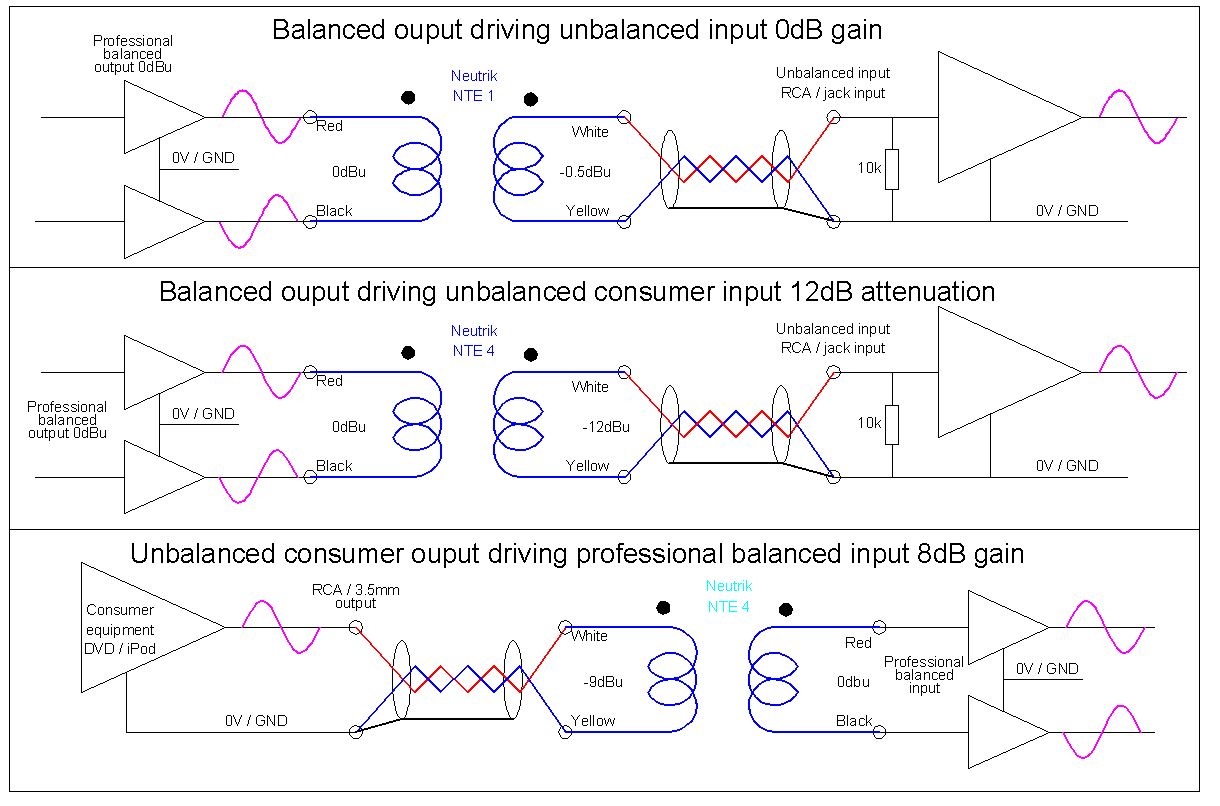
The Problem : I had two sets of equipment that needed to interface with the analogue balanced 0dBu
professional audio infrastructure , DVD recorders in every control room and the Drawmer DS201 dual noise
gates whose Key input is available only as an unbalanced 1/4 inch jack input.
The problem is slightly more complicated though, the Drawmer is professional equipment thus expects a 0dBu
key signal, and thus requires a 1:1 transformer, the consumer equipment has RCA/Phono inputs which expects
a nominal -10dBu input signal. Neutrik come to the rescue with their NTE 1 ( 1:1 ) and NTE 4 ( 1:4 )
transformers which can be mounted in easily available XLR barrels or more usefully in a studio environment, on
a Krone frame - see diagram below ( click picture for larger view )
Bringing consumer equipment into the professional studio environment is always something of a headache, the
levels are 'wrong', the connections are unbalanced and the studio engineer has to spend money buying costly
balance to unbalanced boxes that have to be wedged into a rack somewhere, never a neat solution.
I too faced just this problem here at the installation phase of the BBC Mediacity project in Salford and have
come up with what I believe is an acceptable, rather neat solution to an age old problem.
The Problem : I had two sets of equipment that needed to interface with the analogue balanced 0dBu
professional audio infrastructure , DVD recorders in every control room and the Drawmer DS201 dual noise
gates whose Key input is available only as an unbalanced 1/4 inch jack input.
The problem is slightly more complicated though, the Drawmer is professional equipment thus expects a 0dBu
key signal, and thus requires a 1:1 transformer, the consumer equipment has RCA/Phono inputs which expects
a nominal -10dBu input signal. Neutrik come to the rescue with their NTE 1 ( 1:1 ) and NTE 4 ( 1:4 )
transformers which can be mounted in easily available XLR barrels or more usefully in a studio environment, on
a Krone frame - see diagram below ( click picture for larger view )
Limitations : The NTE 4 wil accept levels up to 8dBu with distortion at 1kHz 0.02%. but rising to 0.07% at
100Hz, indicating that saturation is beginning to occur. This should not be a huge problem, sticking to
0dBu operating levels distortion will be well within most users acceptable limits.
The NTE 1 starts to saturate at around 0dbu from 0.02 to 0.05% upto 8dBu, again well witiin most users
limits.
I have used the NTE 1 as a 1 : 1 transformer for equipment that requires 0dBu, but more interesting
perhaps is using the NTE 4 as an attenuator for driving consumer equipment from babalanced
professional equipment, and the other way around, getting about 8dB of gain when driving from consumer
equipment such as DVD's or iPods to professional equipment.
I have been perhaps a little fast a loose with the explanation of gain and attenuation so i will try to clarify.
The NTE 4 is a 1:4 transformer, so in theory you will measure a voltage four times greater than the input
volatge. When we use the transformer, being driven by a low impedance balanced output, driving into a
high input impedance input such as a DVD, we measure the near theoretical levels of attenuation of 12dB.
Winding ratio 4:1
output Voltage should be 1/4 the input voltage
attenution = 20 log10 ( V1 / V2 ) = 20 log 10 ( 0.25 ) = -12.0
Working the other way around, using the transformer as a 'gain stage' we do not reach theoretical levels
by some margin. The reason is due to input and output impedances which are significant in this
configuration - see the following diagram.
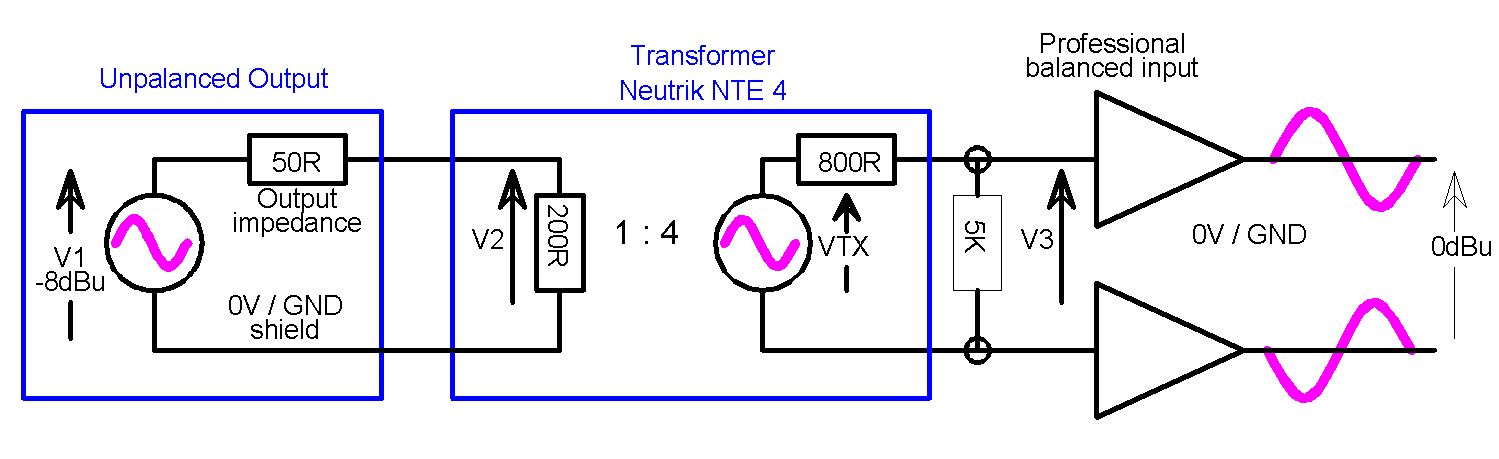
I have shown the transformer as an input impedance, in his case 200 Ohms, and an output impedance of
800 ohms, a ratio of 1:4. I have modelled the transformer input stage simply as a 200 Ohm resistor, the
output stage as a perfect voltage source ( with a gain of 4 ( 20 log 10 (4 ) = 12 dB ) with an output
impedance of 800 ohm.
100Hz, indicating that saturation is beginning to occur. This should not be a huge problem, sticking to
0dBu operating levels distortion will be well within most users acceptable limits.
The NTE 1 starts to saturate at around 0dbu from 0.02 to 0.05% upto 8dBu, again well witiin most users
limits.
I have used the NTE 1 as a 1 : 1 transformer for equipment that requires 0dBu, but more interesting
perhaps is using the NTE 4 as an attenuator for driving consumer equipment from babalanced
professional equipment, and the other way around, getting about 8dB of gain when driving from consumer
equipment such as DVD's or iPods to professional equipment.
I have been perhaps a little fast a loose with the explanation of gain and attenuation so i will try to clarify.
The NTE 4 is a 1:4 transformer, so in theory you will measure a voltage four times greater than the input
volatge. When we use the transformer, being driven by a low impedance balanced output, driving into a
high input impedance input such as a DVD, we measure the near theoretical levels of attenuation of 12dB.
Winding ratio 4:1
output Voltage should be 1/4 the input voltage
attenution = 20 log10 ( V1 / V2 ) = 20 log 10 ( 0.25 ) = -12.0
Working the other way around, using the transformer as a 'gain stage' we do not reach theoretical levels
by some margin. The reason is due to input and output impedances which are significant in this
configuration - see the following diagram.
I have shown the transformer as an input impedance, in his case 200 Ohms, and an output impedance of
800 ohms, a ratio of 1:4. I have modelled the transformer input stage simply as a 200 Ohm resistor, the
output stage as a perfect voltage source ( with a gain of 4 ( 20 log 10 (4 ) = 12 dB ) with an output
impedance of 800 ohm.
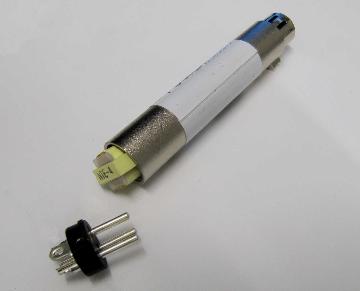
The NTE 1 or 4 will neatly mount into
an XLR barrel giving you a very cost
effective balance, isolator and level
changer all in one.
an XLR barrel giving you a very cost
effective balance, isolator and level
changer all in one.
Mounting onto Krone blocks is easy - see picture below thus it can be incorporated into your professional
infrastructure and documentation very easily and at less that 10 USD each, the transformers offer a very cost
effective method of solving a problem I am sure we have all faced at one time or another.
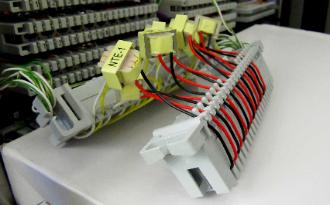
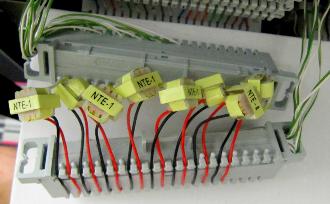
in the pictures below i have used two Krone blocks, lower input, upper Output with up to 10 transformers
wired in, giving 5 stereo channels if required. Apart from the mounting of the transformers ( which I leave free
) it is a very neat solution with no measurable cross talk, and certainly well within limits for a broadcast
environment
Side and top view of multiple NTEs patched into a Krone
infrastructure and documentation very easily and at less that 10 USD each, the transformers offer a very cost
effective method of solving a problem I am sure we have all faced at one time or another.
in the pictures below i have used two Krone blocks, lower input, upper Output with up to 10 transformers
wired in, giving 5 stereo channels if required. Apart from the mounting of the transformers ( which I leave free
) it is a very neat solution with no measurable cross talk, and certainly well within limits for a broadcast
environment
Side and top view of multiple NTEs patched into a Krone
Ohms law tells us that V2 will be equal to V1 * 200 / ( 200 + 50 ) = 0.8 V1
0.8 V1 = 20 log 10 ( 0.8 ) = -1.9 dB : V2 is 1.9 dB lower than V1
The voltage across the transformer is 1.9dB less than the input due to the ratio of output impedance of
driving equipment, and the input impedance of the transformer.
Using Ohm's again at the output side, V3 = VTX * (5000 / (5000 + 800 )) = 0.86 = -1.3 dB
Thus gain of the stage = ( -8dBu - 1.9dB + 12dB -1.3dB ) = 0.8 dB
Thus using the transformer in a 1:4 mode, theoretically we should have 12db gain if we had zero output
impedance from our source and infinite input impedance at the destination equipment.
In the real world we do have output and input impedance, thus from our 12dB theoretical maximum we
loose 3.2 dB, giving us 8.8dB which is pretty much what we measure.
0.8 V1 = 20 log 10 ( 0.8 ) = -1.9 dB : V2 is 1.9 dB lower than V1
The voltage across the transformer is 1.9dB less than the input due to the ratio of output impedance of
driving equipment, and the input impedance of the transformer.
Using Ohm's again at the output side, V3 = VTX * (5000 / (5000 + 800 )) = 0.86 = -1.3 dB
Thus gain of the stage = ( -8dBu - 1.9dB + 12dB -1.3dB ) = 0.8 dB
Thus using the transformer in a 1:4 mode, theoretically we should have 12db gain if we had zero output
impedance from our source and infinite input impedance at the destination equipment.
In the real world we do have output and input impedance, thus from our 12dB theoretical maximum we
loose 3.2 dB, giving us 8.8dB which is pretty much what we measure.